


| Price | RM20.00 |
| Product SKU | 1D1-1N5-K006 |
| Brand | Kadaiku |
| Size (L x W x H) | 15 cm x 1 cm x 21.5 cm |
| Availability | In Stock |
| Quantity |
|
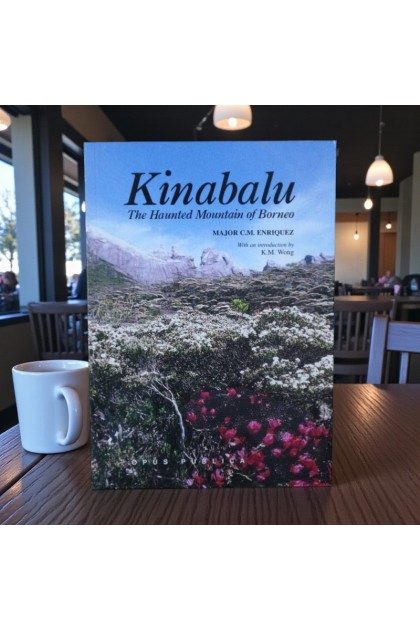
Enriquez’s short account, ‘Kinabalu – The Haunted Mountain Of Borneo’ requires only a brief introduction in that it is a succinctly composed record of an expedition to Borneo in 1925, made principally to collect zoological specimens. This was when Borneo was a far-away land of orang-utan and headhunters, savagery and piracy and when (under the British North Borneo Company) “the question of communications remains… in the air.” It is still a far-away land of orang-utan for many Europeans, but the headhunting and the savagery have gone, remaining only in the annals of the past.
The reader can finish the book in one or two days at the most, but the admirer of Kinabalu and a keen collector of Borneo literature will notice that some of the most beautifully written passages on Kinabalu portray its starkness and many wonderful moods exist in Enriquez’s book. Even in those days, at a time when it was thought there had been only 25 documented visits and sacrificial rites were an essential condition to climb the mountain, he notes that “ Kinabalu is a sort of Mecca for naturalists.” Enriquez was a military man and a sort of naturalist, knowledgeable about butterflies and birds and, although not a resident of North Borneo, makes some rather sharp observations on natural history aspects of the mountain. He comes across as a curious visitor enchanted with Kinabalu, and such in a state prone to forgetting himself, although understandably so. He declares his book seeks to “avoid… the deplorable terminology beloved of scientists” but (even as he refers to spiders as those “unpleasant insects”) engages in mentioning suites of Latin names of butterflies and birds, which otherwise are charmingly described. Some of his observations on the races and customs of North Borneo may appear colored and unacceptable, as can understandably be made by a member of any administrating party over their colonial charges, (and indeed, some of the most unusual stories could be an uncritical repetition of what has been related to the apprehensive traveler), but Enriquez displays his fondness for the gentle aspects to his Kachin companion from Burma, Sau Nan, an associate from the British Indian army, and by declaring, in connection with his North Borneo experience, that “superstitions… denote a sense of humiliation in the presence of great forces where perhaps more arrogant people betray a profound ignorance by ridiculing them”. This is a wonderful mixture of attempts at accurate natural history observations and calm expressions of what has been today called culture shock.